
Event Details
Dates
28/02/2026 – 26/04/2026
Time
Tuesday - Saturday 10:00 - 17:00
Late opening every Thursday 10:00 - 21:00
Sunday 12:00 - 17:00
(Closed Mondays)
Location
Galway Arts Centre | 47 Dominick Street
Event Type
Exhibition,
Additional Info
Opening Reception Fri 27 February at 6:00pm
Galway Arts Centre in partnership with the Irish Museum of Modern Art (IMMA) are pleased to present a group exhibition usual and generous ways curated by writer and poet Padraig Regan.
This exhibition brings together works from the collection of the Irish Museum of Modern Art, rock samples from the James Mitchell Geology Museum, a selection of historical maps and diagrams, and material from Robinson’s archive held at University of Galway to explore how artists and scientists have tried to give visual expression to the processes that have shaped our physical surroundings. Including works by artists; Richard Long, Barrie Cooke, Damien Hirst, Dorothy Cross, Seiha Kurosawa, David Beattie, Patrick Ireland/Brian O’Doherty, Patrick Hall, Anne Madden, Hilary Heron, Hamish Fulton and Brian King.
usual and generous ways presents works from artists working across a range of media, from Ireland and elsewhere, in which stone is not just a material to be shaped by the artist’s hand, but a subject-matter, an object of inquiry, and an agent to be thought-with and thought-through.
Looking towards the dramatic limestone coast of Inis Meáin, the artist, author and cartographer Tim Robinson wrote:
“In some places the scarp-faces […] are considerable cliffs of up to twenty feet in height, in others they dwindle to broken slopes so that the terraces are not immediately distinguishable and it would be hard to count them, while elsewhere minor subdivisions become more prominent than these major ones — and in the face of these, the usual and generous ways of reality, any diagram having done its work goes on to demonstrate its own inadequacy.”
In the 18th Century, through the study of fossils, scholars slowly began to propose that the life-span of the Earth must far exceed the 6000 year chronology suggested by the Biblical narrative. This discovery of geological deep-time, without which the subsequent discovery of evolution by natural selection would have been impossible, marked a radical turning-point in humanity’s understanding of its place in the universe: no-longer was ‘man’ the apex of creation but only one of many flowerings of life that have taken place since the formation of the Earth.
At the beginning of the 19th Century, this rapidly burgeoning understanding of geology was put to use in fuelling the Industrial Revolution. The search for coal, oil, metallic ores and other useful minerals propelled much geological research, and still continue to do so to the present day.
In Ireland, the promise of finding economically valuable mineral reserves in combination with a quasi-philanthropic desire to improve public understanding of science within the country led to a number of attempts to survey the geological makeup of the island by a number of researchers and public bodies. Though all were working under the bureaucratic aegis of the British Empire, individual egos and questions over institutional remits often led to frayed relations between the various map-making enterprises, until the British Government established the Geological Survey of Ireland in 1845, and sent out their first field teams into the south-west counties on the eve of the Great Hunger. This history will be made present in the exhibition through a selection of maps, diagrams and other research documents.
In addition to this, rock samples loaned by the James Mitchell Geology Museum are included to showcase the aesthetic potentials of rocks and the processes that have given rise to them: faulting, banding, inclusion, sedimentation, erosion, etc.
The ideas behind the exhibition will also be explored in a new text by the curator, to be added to the exhibition as part of Cúirt International Festival of Literature 2026.
The exhibition has been developed through Galway Arts Centre’s inaugural Writer in Residence programme 2025-2026, developed in partnership with Cúirt International Festival of Literature.
Image: Map courtesy of GSNI
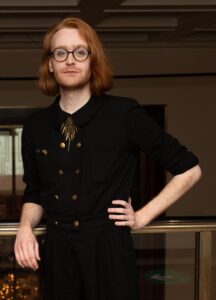
Padraig Regan is a poet and essayist based in Belfast, with interests in the relationship between writing and the visual arts. Their debut collection of poems Some Integrity was published in 2022 by Carcanet and shortlisted for the Forward Prize for Best First Collection. Their second book, The Matter, is forthcoming in 2026, also from Carcanet. From 2022-2024, they were a Fellow Commoner in Creative Arts and in 2025, they were a Burgess Fellow at the Centre for New Writing, University of Manchester.